
Why Forestry Operators Are Switching to Polycarbonate Doors
Why Forestry Operators Are Switching to Polycarbonate Doors
Forestry operators are switching to polycarbonate doors because the work moved onto everyday skid steers and compact track loaders — and the attachment makers, the loader OEMs, and the purpose-built forestry machine builders now all point the same direction. Mulchers and cutters throw debris hundreds of feet, factory cab glass shatters when it's hit, and polycarbonate is the material the industry has settled on to keep the operator protected without losing the view.
All prices listed are accurate as of October 2026 and may change over time. For current pricing, check the live product pages linked throughout this article.
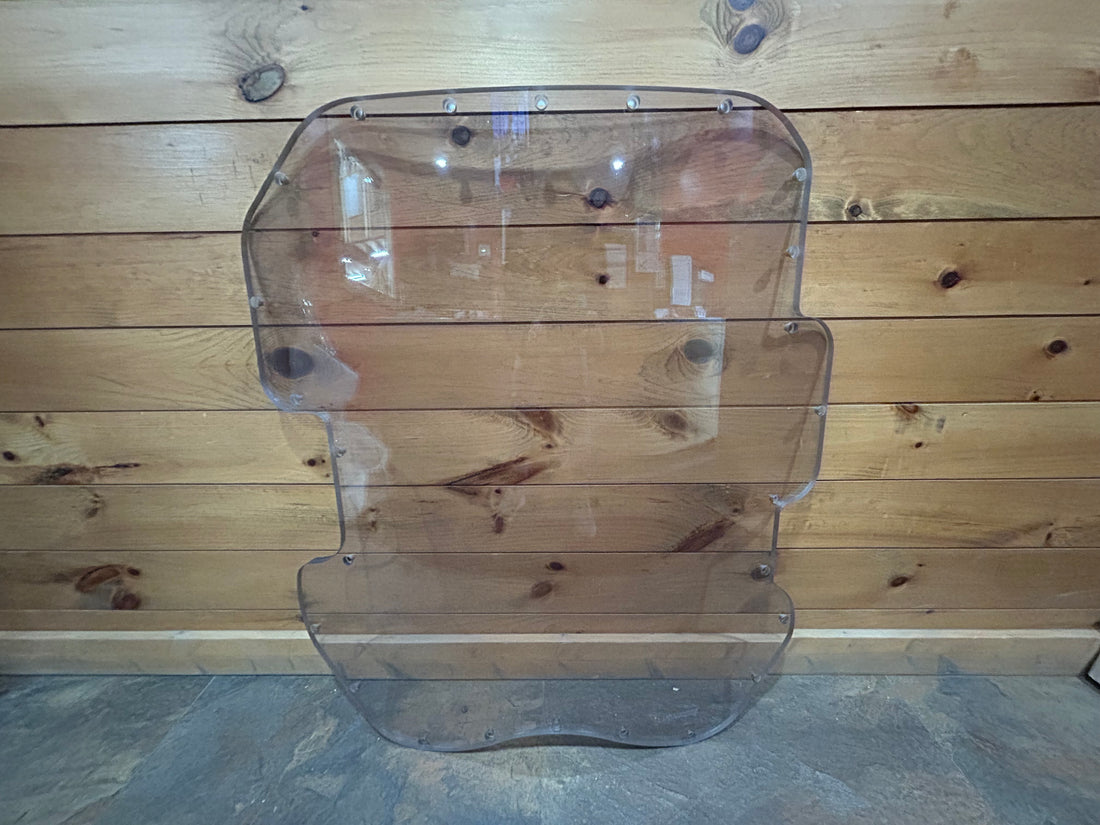
A 3/4" laminated polycarbonate forestry windshield — the same material class OEMs now build into their forestry door kits.
In This Article
- The short answer: 5 reasons operators are switching
- Forestry work moved onto compact loaders
- Attachment makers now require it
- OEMs build forestry packages around polycarbonate
- Purpose-built forestry machines already use it
- Visibility: why clear poly beats steel screens
- The downtime and cost math
- What you give up (and how to manage it)
- Three ways to make the switch
- How to choose your path
- FAQ
The Short Answer: 5 Reasons Operators Are Switching
This isn't a marketing trend. It's the result of five things happening at once:
| Driver | What Changed | Why It Pushes Operators to Polycarbonate |
|---|---|---|
| 1. The machines | Mulcher heads now exist for standard-flow skid steers, not just high-flow forestry carriers | More general-purpose machines with factory glass are doing forestry work |
| 2. The attachment makers | Mulcher manufacturers state a shatter-resistant enclosure is mandatory | Running a cutter behind standard glass goes against the attachment's own manual |
| 3. The loader OEMs | Forestry kits ship with laminated polycarbonate doors — some with an interlock | The OEM's own forestry spec is polycarbonate |
| 4. Purpose-built forestry machines | Harvesters, forwarders, and feller bunchers use thick polycarbonate glazing | The machines designed from day one for the woods already made the call |
| 5. The economics | Downtime and repeat glass replacements cost more than the upgrade | Polycarbonate turns a recurring repair into a one-time purchase |
Each of these is covered below with the source behind it. If you're looking for a straight material comparison instead, we cover that in polycarbonate vs. glass for skid steer and excavator windows.
Reason 1: Forestry Work Moved Onto Compact Loaders
Land clearing used to belong to dedicated forestry carriers. Today a large share of it is done with skid steers and compact track loaders (CTLs) running mulcher heads, brush cutters, and forestry cutters. That shift is the root cause of the polycarbonate switch.
Two things opened the door. First, high-flow compact loaders became common — Diamond Mowers' skid steer forestry mulcher, for example, is designed for high-flow machines in the 32–45 GPM range. Second, mulcher makers started building heads for standard-flow machines. Fecon's Bull Hog RK6015, introduced in 2023, runs on skid steers and CTLs in the 17–27 GPM range.
That means a loader that was ordered for grading, loading, or snow work — with a factory glass front door — can now be running a mulcher next week. The attachment changed the hazard. The door didn't change with it.
Reason 2: Attachment Makers Now Require It
The companies that build forestry mulchers are explicit: don't run their heads without a shatter-resistant cab enclosure. This is one of the biggest reasons operators are switching — it's in the attachment's own paperwork.
- Diamond Mowers (skid steer forestry mulcher manual): "This product must not be used without a shatter resistant cab enclosure." The maintenance section labels the enclosure "REQUIRED!" and warns that "debris can be thrown unexpectedly in any direction." On its safety polycarbonate page, Diamond lists a minimum 1/2" thick polycarbonate operator protection requirement, noting some applications need more.
- Fecon (RK6015 standard-flow mulcher): "the carrier must include a fully enclosed cab protected with the appropriate polycarbonate guarding."
- Bobcat (forestry cutter): requires "a complete forestry kit installation before operation."
If you run someone else's attachment against their written requirement and the door fails, you're the one explaining why. For owner-operators, contractors, and especially rental fleets, that's reason enough to switch.
Reason 3: Loader OEMs Build Their Forestry Packages Around Polycarbonate
When the loader manufacturers spec a machine for forestry, they don't use thicker glass — they use polycarbonate.
Bobcat is the clearest example. Its forestry guidance compares the standard glass door — which it describes as 6 mm thick — with a 3/4-inch-thick laminated polycarbonate forestry door, and recommends replacing the standard top, rear, and side windows with 1/4-inch to 1/2-inch polycarbonate. Bobcat also built an electronically controlled valve into its forestry cutter package that ensures the forestry door is installed before the attachment can be used. The forestry door includes a front emergency exit so the operator still has a way out.
John Deere offers a factory forestry package door on its G-Series skid steers and CTLs (OEM door #T478319 on the 320G–333G). Across brands, the pattern is the same: the OEM's answer to forestry duty is a polycarbonate door, not a glass one.
Reason 4: Purpose-Built Forestry Machines Already Use It
The machines engineered from day one for the woods — harvesters, forwarders, feller bunchers, and processors — have used polycarbonate cab glazing for years. Compact loader operators are catching up to a decision the forestry machine builders already made.
- Tigercat uses polycarbonate in its operator station windows, with cab window thickness ranging from 9 mm to 32 mm (0.375" to 1.25") depending on falling-object (FOPS) and operator-protection (OPS) requirements, window size, and how close the window sits to the hazard. Tigercat states that properly installed polycarbonate windows don't require external steel mesh guards.
- John Deere forestry used 12 mm curved solid polycarbonate panels — five per cab — in its E-Series harvesters and forwarders, chosen to keep thick branches, stones, and broken winch cable from penetrating the cab.
- KRD's KASIGLAS polycarbonate glazing, used by forestry machine manufacturers including John Deere, has reportedly been fitted to more than 2,000 forest machine cabs.
Chain Shot: The Hazard That Settled It for Harvesters
Chain shot is when a saw chain breaks and the whipping action throws a chain link outward like a bullet. According to Forest Machine Magazine, a harvester chain normally runs at about 40 m/s, but a broken chain can accelerate a link to as much as 309 m/s — roughly 690 mph. There is now a dedicated standard for windows on these machines: ISO 21876:2020, which sets the test method and performance criteria for saw chain shot protective windows on forestry machines — including excavators converted with a saw head. (A separate standard, ISO 11837, covers chain shot guarding systems.)
Visibility: Why Clear Polycarbonate Beats Steel Screens
The old fix for flying debris was a steel mesh screen or cage over the glass. Operators are moving away from it because a screen protects the glass by blocking part of the view.
In mulching and selective clearing, visibility is a safety control in its own right: you need to see stumps, rocks, fence wire, and the person who walked into your work zone. Tigercat's position that properly installed polycarbonate windows don't need external steel mesh guards — giving the operator a clearer view — reflects the main advantage. A polycarbonate door is both the window and the shield.
Polycarbonate is also about half the weight of laminated safety glass at the same thickness, according to a polycarbonate sheet manufacturer writing for the IAPD, which matters on a door that swings, latches, and gets opened dozens of times a day. Want less glare on long sun-facing days? See tinted vs. clear skid steer windshields.
The Downtime and Cost Math
Operators switch because one broken glass door costs more than the glass. It costs the rest of the day, the cleanup, the trip to get a replacement, and the job you didn't finish — and on a cutter machine, the replacement glass is just waiting for the next limb.
Here's what the pricing landscape looks like right now:
| Option | Example | Price (Oct 2026) |
|---|---|---|
| OEM forestry door kit (complete) | Bobcat Forestry Door Kit for Skid Steer Loaders, P/N 7319020 — 3/4" curved laminated polycarbonate, frame, seal, gas spring, hardware | $4,964.99 (Bobcat parts store list) |
| Replacement panel for an OEM forestry door | Bobcat M-Series 3/4" laminated forestry windshield | $1,999 |
| Polycarbonate windshield for a standard door | Bobcat G-Series windshield · Kubota SVL windshield | From $592 · From $499 |
Real-world quotes follow the same pattern. One contractor on HeavyEquipmentForums reported a dealer quote of over $4,000 for a Case demolition door, versus roughly $400 for replacement glass — and went with an $800 aftermarket 1/2" polycarbonate panel instead. That's why operators who've broken glass more than once stop buying glass. (We break down the repeat-replacement cycle in why your skid steer door keeps breaking.)
What You Give Up (And How to Manage It)
Polycarbonate isn't perfect, and operators who switch should know the trade-offs going in. None of them are deal-breakers — but ignoring them is how a good door fails early.
1. It scratches more easily than glass
Polycarbonate is softer than glass. Quality forestry panels carry a hard coat for abrasion and UV resistance, but grit still wins if you let it. Bobcat recommends clearing rocks and debris from the wiper blade before running the wipers and avoiding abrasive cleaners. Never dry-wipe a dusty panel, and skip ammonia-based glass cleaners — see the care section in our brush cutting door guide.
2. It expands and contracts with temperature
Polycarbonate grows and shrinks far more than the steel frame around it. SABIC's LEXAN sheet data lists a coefficient of thermal expansion of 3.75 × 10⁻⁵ in/in/°F — roughly five to six times that of steel. On a 40-inch panel, a 100°F temperature swing works out to about 0.15" of movement. One contractor who hard-bolted a 1/2" panel with about 20 tight fasteners reported it cracked at nearly every hole on a 100°F day. The lesson: use the mounting method the windshield was designed for, and don't drill and clamp a panel tight on your own.
3. The frame matters as much as the panel
Tigercat's guidance is that a polycarbonate window must stay fully and evenly supported around its edges, and that bent or dented cab structures must be evaluated right away. A panel sitting on a racked or rusted frame won't seal or carry load correctly. If your frame is shot, fix the frame — don't just swap the panel.
4. Inspect it — it's protective equipment
Tigercat recommends inspecting polycarbonate windows daily and after any impact, including the steel structure around the mounting. Bobcat says to talk to your dealer about replacement if a window or door is scratched, cracked, or otherwise damaged. Deep gouges and cracks reduce what the panel can absorb next time.
5. Keep your emergency exit
On most skid steers and CTLs, the front door is the way in and out. OEM forestry doors, like Bobcat's, include an emergency exit feature. Whatever you install, make sure the door still opens, latches, and lets the operator out the way the machine was designed.
Three Ways to Make the Switch
How you switch depends on what's on your machine today. Pick the path that matches your current door — the wrong part is the most common mistake we see (more in top 5 mistakes when buying a skid steer door).
Path A: Standard Glass Door → Polycarbonate Windshield
This is the most common switch. You keep the factory door frame and replace the glass with a polycarbonate windshield cut to match it. It's the lowest-cost route into polycarbonate for brush cutting and mulching.
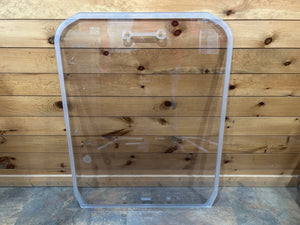
Kubota SVL Front Windshield Replacement Only
Polycarbonate front windshield for the Kubota SVL65–SVL97 family, bonded to the existing door frame with VHB tape or urethane. Full model breakdown in our Kubota SVL buyer's guide.
View Kubota SVL Windshield →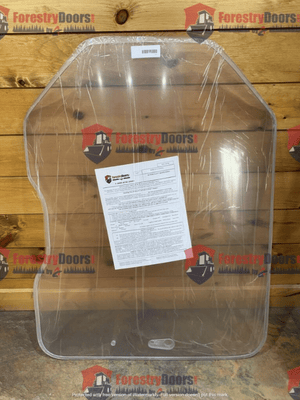
Bobcat G-Series Windshield Replacement Only
1/4" or 1/2" polycarbonate replacing OEM glass #6729776. Fits G-Series skid steers S100–S330 and track loaders T150–T320, with milled edges and duplicated mounting holes. Confirm your wiper style before ordering.
View Bobcat G Windshield →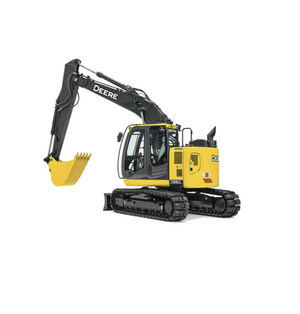
John Deere G (75G–245GLC) Excavator Windshield — Polycarbonate
Polycarbonate upper and lower windshields for John Deere 75G, 135G, and 245GLC excavators, replacing OEM glass #T505369 (upper) and #T396405 (lower). Clear or tinted, abrasion-resistant coating on both sides.
View JD Excavator Windshield →Path B: Already Have an OEM Forestry Door → Replace the Panel
If your machine already has the factory forestry door and the polycarbonate is scratched, gouged, or cracked, you don't need a whole new kit — you need the panel. These replacements are made for the OEM forestry frame only and won't fit a standard glass door.
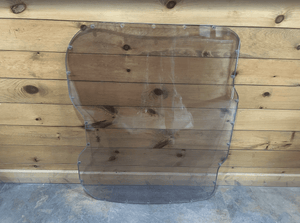
Bobcat M-Series 3/4" Laminated Forestry Windshield Replacement
3/4" laminated polycarbonate replacement panel #7193293 for use only with Bobcat Forestry Door Kit #7326358. Fits M-Series S450–S850 and T450–T870. Also available for G-Series (kit #7140090) and R-Series forestry packages.
View 3/4" Laminated Panel →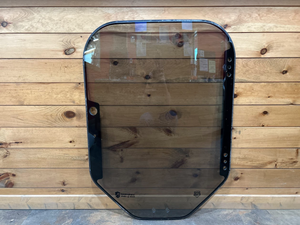
Bobcat M-Series 2-Hole Forestry Windshield Replacement #7155308
1/2" polycarbonate, clear or 40% tint, replacing the Bobcat 1/2" forestry windshield #7155308 on machines with Bobcat frame #7155359. Not for machines with OEM glass.
View Bobcat 2-Hole Forestry →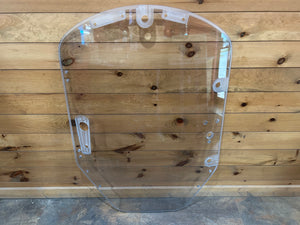
John Deere G-Series Forestry Windshield Replacement #T478319
Replaces the polycarbonate in John Deere's factory forestry package door #T478319 on the 320G, 324G, 325G, 330G, 331G, 332G, and 333G. Clear or 50% tint. Does not replace OEM glass.
View JD Forestry Windshield →Path C: Bent Frame or Full-Time Forestry → Frame + Polycarbonate
If the factory frame is bent, racked, or rusted — or the machine lives in the brush full time — start from a new structure instead of bonding a good panel to a tired frame.

Heavy-Duty Front Door Frame & Polycarbonate Windshield Kit for Kubota SVL
A heavy-duty door frame and polycarbonate windshield as one system for SVL operators doing full-time mulching and land clearing.
View SVL Door Kit →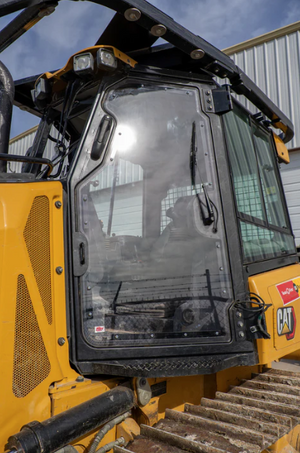
Caterpillar D1–D6K2 Polycarbonate Driver Door
Polycarbonate driver door for Cat D1–D6K2 dozers, replacing OEM 281-4141. Dozers pushing timber and clearing right-of-way take the same limb strikes as loaders. Browse all Caterpillar dozer doors.
View Cat Dozer Door →Mounting Supplies for Bonded Windshields
Bonded polycarbonate windshields go in with industrial VHB tape or urethane — not hardware-store double-stick, and not tight bolts drilled on your own. Walk through our installation guide before you start.

3M VHB 5952 Double-Sided Tape
Industrial bonding tape for polycarbonate windshield installs — no cure time.
View 3M VHB Tape →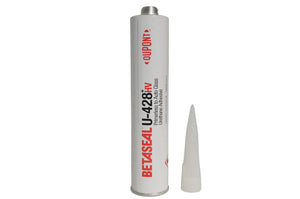
Dow U-428 Urethane Adhesive
High-strength, flexible urethane bonding sealant for a fully sealed windshield joint. Allow setup and cure time before returning the machine to work.
View Urethane Adhesive →How to Choose Your Path
Start with two questions: what door is on the machine right now, and what's the worst thing it will hit? Then use this table. (Starting prices as of October 2026.)
| Your Situation | Path | Starting Price |
|---|---|---|
| Standard glass door, good frame, starting to run a brush cutter or mulcher | A — Polycarbonate windshield for your standard door | $379–$592 (by machine) |
| Factory OEM forestry door with scratched or cracked polycarbonate | B — Replacement forestry panel (match your kit/part #) | $828–$1,999 |
| Bent, racked, or rusted frame — or full-time forestry | C — Heavy-duty frame + polycarbonate | From $2,499 (Kubota SVL kit) |
| Dozer clearing timber or right-of-way | Polycarbonate dozer door | From $799 |
Before you order, have these ready:
- Make, model, and series — e.g., Bobcat M-Series T770, John Deere 333G, Kubota SVL75-3.
- Serial number — the surest way to lock in fitment.
- The part number on your existing door or window — this tells us whether you have standard glass or an OEM forestry door.
- Your attachment — mulcher, brush cutter, forestry cutter, or grapple — and check its manual for any minimum polycarbonate requirement.
- Thickness — see how thick a skid steer polycarbonate door should be.
Doing serious clearing? Polycarbonate protects the operator's view; steel protects the machine. Pair the door with skid steer armor for light guards, coupler guards, and roof protection.
Ready to Make the Switch?
Polycarbonate windshields, forestry door panels, and dozer doors for skid steers, compact track loaders, excavators, and dozers — matched to your machine and OEM part number.
Shop Polycarbonate Doors → Not Sure Which Fits? Talk to UsFAQ: Switching to Polycarbonate Forestry Doors
Why are forestry operators switching from glass to polycarbonate?
Because more forestry work is being done with skid steers and compact track loaders, and the mulchers and cutters they run throw debris that shatters factory glass. Mulcher manufacturers such as Diamond Mowers and Fecon require a shatter-resistant or polycarbonate-guarded cab, OEMs like Bobcat build their forestry doors from laminated polycarbonate, and purpose-built forestry machines from Tigercat and John Deere already use polycarbonate glazing.
Is a polycarbonate door required to run a forestry mulcher on a skid steer?
Check your attachment's manual — many say yes. Diamond Mowers' skid steer forestry mulcher manual states the product "must not be used without a shatter resistant cab enclosure" and lists a minimum of 1/2" polycarbonate, and Fecon requires a fully enclosed cab with polycarbonate guarding for its RK6015. Bobcat requires a complete forestry kit before its forestry cutter is used.
How thick is a factory forestry door compared to standard glass?
Bobcat describes its standard glass door as 6 mm thick and its forestry door as 3/4-inch laminated polycarbonate. On purpose-built forestry machines, Tigercat cab windows range from 9 mm to 32 mm depending on the application.
Can I put a forestry replacement panel on a machine with a standard glass door?
No. Forestry replacement panels — like the Bobcat M-Series 3/4" laminated panel or the John Deere #T478319 forestry windshield — fit only machines that already have the OEM forestry door frame. For a standard door, buy the polycarbonate windshield made to replace your OEM glass part number.
What Bobcat forestry door kit do I have?
Check the part number on your door. Our G-Series 3/4" laminated panel is for Bobcat Forestry Door Kit #7140090 (polycarbonate #7189822), and our M-Series 3/4" laminated panel is for kit #7326358 (panel #7193293). The M-Series 1/2" forestry windshield #7155308 uses Bobcat frame #7155359. Bobcat's current online parts store lists a Forestry Door Kit for Skid Steer Loaders as P/N 7319020. If your numbers don't match, contact us before ordering.
Does polycarbonate stop chain shot?
Polycarbonate is the material used for chain-shot-resistant windows on forestry machines, but a window is only chain-shot rated if it's tested for it. ISO 21876:2020 sets the test method for saw chain shot protective windows, including on excavators fitted with saw heads. A standard skid steer or excavator polycarbonate windshield is an impact upgrade over glass, not an automatic chain shot rating — confirm with your machine or attachment OEM if you run a saw head.
Does polycarbonate scratch?
Yes — more easily than glass. Forestry-grade panels have a hard coat for abrasion and UV resistance. Clear rocks from the wiper before using it, rinse grit off before wiping, avoid abrasive cleaners, and inspect the panel regularly.
Can I drill and bolt a polycarbonate windshield myself?
We don't recommend it. Polycarbonate expands roughly five to six times as much as steel with temperature, and panels bolted tight can crack at the holes on a hot day. Use the mounting method the windshield was designed for — bonded with 3M VHB tape or urethane, or a purpose-built fastening system.
Does polycarbonate work on excavators and dozers too?
Yes. Excavators doing land clearing and dozers pushing timber take the same limb strikes. Forestry Doors offers polycarbonate windshields for John Deere excavators and other excavator brands, plus Caterpillar dozer doors.
Does my purchase qualify for sales tax exemption?
If you're buying for a qualifying farm or business, you may be exempt. See our tax exemption page before checkout.
The Bottom Line
Forestry operators aren't switching to polycarbonate because it's new. They're switching because the work changed — compact loaders now run mulchers and cutters every day — and every group that builds forestry equipment, from the mulcher makers to the loader OEMs to the harvester builders, has already landed on polycarbonate. If your machine runs anything that throws material, match the door to that job: a polycarbonate windshield for a standard door, a replacement panel for an OEM forestry door, or a full frame and windshield when the frame is done. Then mount it right and inspect it like the safety equipment it is.
← Back to the Forestry Door Blog